You're standing in your garage, looking at concrete that's either bare and stained or wearing a coating that already peeled under hot tires, and you keep running into two words online — "polyaspartic" and "polyurea" — that nobody bothers to explain. Maybe a DIY kit let you down. Maybe three contractors quoted three different things. Either way, you don't need a chemistry degree. You need a straight answer about what actually fits your floor. That's where we come in for Southport homeowners. At Southport Remodeling we install both epoxy and polyaspartic systems, so our advice isn't tied to the one product we happen to sell.
What a Polyaspartic Coating Actually Is
Let's keep the jargon simple. Polyaspartic is part of the polyurea family of floor coatings, and it's one of the coatings we offer here at Southport Remodeling. In plain English, it's a fast-curing, tough finish that holds up well to sunlight and handles moisture better than a lot of older coatings.
The two features people care about most are UV stability and cure speed. UV stability means the coating resists the yellowing you've probably seen on floors that sat in sunlight too long. The fast cure means the material sets up quickly once it's applied. It's a moisture-tolerant finish, which matters on concrete slabs that pull a little dampness from below. You'll hear it called polyurea floor coating too — same general chemistry, just different branding depending on who's talking.
Epoxy or Polyaspartic: Which Fits Your Floor
Here's the honest version, and we can give it to you straight because we sell both. Neither one is "the winner." They're different tools for different situations, and the right pick depends on your floor, not on what's easiest for us to push.
Epoxy has been the go-to garage floor coating for years. It builds a thick, solid base and it's usually the friendlier option on budget. Polyaspartic tends to cure faster and holds its color better under sunlight, which is why it shows up a lot on floors that see UV exposure or need to be back in service quickly. A good number of jobs actually use both — an epoxy base coat with a polyaspartic topcoat — to get the best of each.
When we walk your space, we're looking at how the floor gets used, how much light hits it, how fast you need it back, and what you want to spend. Then we tell you which system makes sense. That's the whole point of carrying both under one roof — the recommendation follows the floor.
If that sounds like the kind of no-pressure answer you've been after, call us at (910) 899-8587 and we'll talk through your floor.
Where Polyaspartic Coatings Make Sense
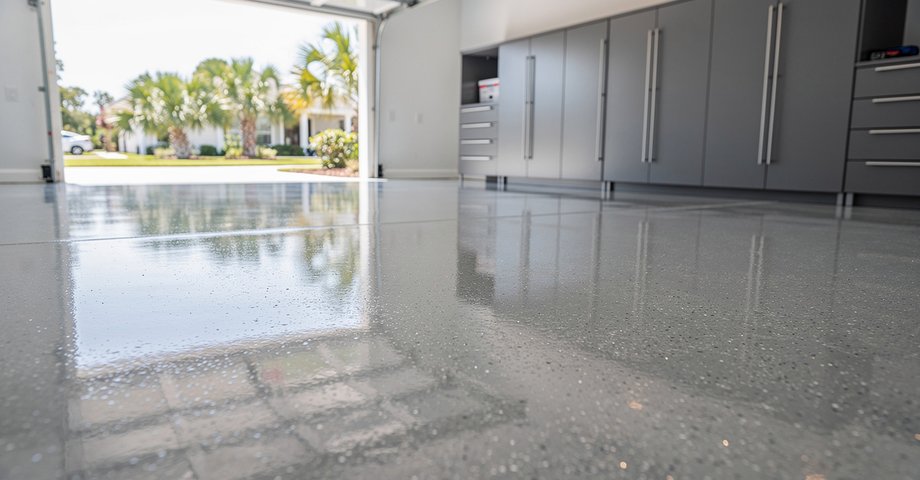
The most common spot is the garage. A durable garage floor finish takes a beating — hot tires, dropped tools, oil drips, foot traffic — and a polyaspartic coating is built for that kind of abuse. But it's not just garages. Any interior concrete floor that you want cleaner, brighter, and easier to maintain is a candidate.
If you like the look of a chip flake floor system, that decorative flake can be broadcast into the coating while it's wet. You get a speckled, textured finish that hides minor imperfections and gives the floor some grip underfoot. Workshops, utility areas, laundry spaces, and plain concrete slabs around the home all work well with a polyaspartic system. The question we always come back to is simple: how do you use the space, and what do you want it to do for you?
Coating the Slab, Building the Cover
Here's something a lot of homeowners don't realize they can bundle. We do covered patio improvements and deck construction and remodeling, not just floor coatings. So if you've got a slab under a covered patio — or you're adding a cover over one — the same crew that builds the structure above can finish the concrete below.
That pairing makes real sense when you think about UV exposure. A semi-outdoor slab catches sunlight and weather in a way an enclosed garage never does, and a UV-resistant coating is exactly what belongs there. Having one contractor handle the cover and the finish keeps the whole project lined up instead of juggling two companies who each blame the other.
Why Cure Speed Changes Your Project
The real worry behind "fast-curing floor coating" searches isn't chemistry. It's downtime. How many days am I parking in the driveway? How long before I can move everything back in? Nobody wants their garage out of commission for a week.
This is where polyaspartic earns its keep. As a product category, these coatings return a floor to use faster than traditional epoxies — the material cures more quickly, so the gap between "wet floor, stay off" and "back to normal" is shorter. We won't hand you a guaranteed hour count on a web page, because the real timeline depends on your slab, the finish you choose, and the weather that week. But the short version is this: polyaspartic is the option people reach for when getting the space back quickly matters. We'll give you an honest schedule once we've seen the floor.
Serving Southport and Brunswick County
We're local, and we work throughout Southport and the surrounding coastal communities of southeastern North Carolina. If you're in Oak Island, Shallotte, Leland, Calabash, or Wilmington, you're within the area we cover.
Being a local concrete coating contractor means we're not driving in from three counties away and rushing off. We show up, look at your actual floor, and talk through the options that fit it. Whether it's a garage in Southport or a patio slab closer to the coast, we treat the job the same way — with the care we'd want on our own home. Give us a call and we'll figure out the right plan for your space.
The easiest next step is just a conversation. Tell us about your floor — where it is, how it gets used, what's gone wrong with it before — and we'll help you sort out whether epoxy, polyaspartic, or a combination is the better fit. No pressure, no pushing one product because it's the only thing we carry. Call Southport Remodeling at (910) 899-8587 and let's talk about what your concrete could look like.