
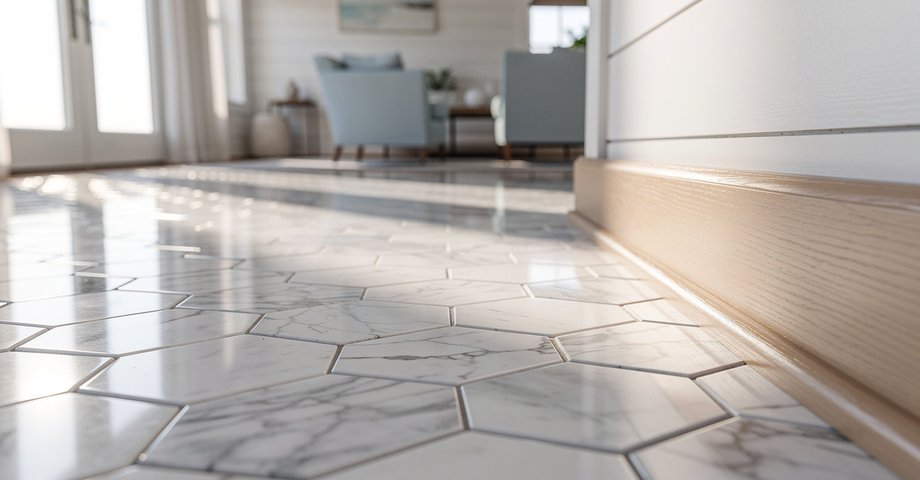
You've probably seen a bad tile job. Maybe it was a friend's kitchen where the grout darkened within a year, or a bathroom where one corner of the floor felt hollow and loose under your foot. Tile is the flooring you don't get to redo on a whim. When it's set right, it outlasts almost everything else in the house. When it's rushed — or laid over a subfloor that was never prepped properly — you live with the cracks, the lippage, and the stained grout lines for a very long time. That's the honest truth about tile for any Southport homeowner, and it's exactly why the details matter so much.
Tile Flooring Installation in Southport, NC
Tile flooring is part of our remodeling work here at Southport Remodeling. It isn't a side offering we tack on to fill a schedule. It's something we do deliberately, with the same hands-on attention we bring to every project. When we install a floor in a Southport home — whether you're out on Oak Island, over in Leland, or down in Shallotte or Calabash — we want it to look right the day it's finished and still look right years from now. We serve homeowners across Brunswick County and the surrounding coastal communities, and we treat each floor like it's going into our own home.
Porcelain, Ceramic, and Natural Stone Tile
Picking the material is one of the first real decisions you'll make, and each option behaves differently once it's on the floor. Porcelain is dense and fires at a higher temperature, which makes it harder and less porous — a good fit for busy rooms and spots that see water. Ceramic is a bit softer and usually easier on the budget, and it does fine in rooms that don't take a daily beating. Natural stone — travertine, marble, slate — brings a look nothing manmade quite matches, but it's porous by nature. That means it needs sealing and a little more care over its life.
There's no single "best" tile. The right choice depends on the room, the traffic it sees, and how much upkeep you're willing to take on. We're happy to walk through the trade-offs with you so the floor fits how you actually live.
Subfloor Preparation Determines Everything
Here's the part most people never see, and it's the part that decides whether your floor lasts. Tile is rigid. It doesn't flex. So if the surface underneath moves, shifts, or isn't dead flat, the tile and grout take the stress — and that's where cracking, popping, and hollow spots come from. A floor that bounces will telegraph that movement straight up through the grout lines.
Good prep means making sure the subfloor is sound, stiff enough to carry tile, and flat within tolerance before a single piece goes down. Lippage — that annoying unevenness where one tile edge sits higher than its neighbor — usually traces right back to a surface that wasn't leveled first. We'd rather spend the extra time underneath than hand you a floor that fails in two years.
If you've got a floor that's already giving you trouble and you want a straight answer about what's going on underneath, call us at (910) 899-8587 and we'll talk it through.
Custom Patterns and Large Format Tile
If you've been saving floor photos — herringbone, a wood-look plank layout, oversized slabs that read almost seamless — those looks are absolutely doable, and the layout is a big part of the final feel. Running tile on a diagonal, setting a herringbone, or mixing sizes all change how a room reads. Each pattern also means more cuts and more planning so the lines land where they should.
Large format tile is its own animal. Those big pieces look clean and modern, but they're unforgiving. The bigger the tile, the flatter the floor has to be, because any dip shows up as lippage along those long edges. It takes more care to set well, and that care is exactly where a careful install earns its keep.
Waterproof Tile for Kitchens and Bathrooms
Tile earns its reputation in the rooms where water lives. Kitchens, bathrooms, laundry rooms, entryways off the yard — these are the spots where other flooring warps, peels, or swells, and where well-set tile just keeps going. Porcelain in particular shrugs off spills and mopping, which is why it's such a common pick for busy households.
Something worth knowing before you start: a lot of kitchen tile projects don't stay just about the floor. Once that new floor goes in, the old countertops or cabinets can suddenly look tired by comparison. Because we also do kitchen remodeling, a floor project can grow into a fuller kitchen update under the same roof — same crew, same standards, no juggling separate contractors. If that's where your head goes mid-project, we can pick up right where the floor leaves off.
Repair, Removal, and Full Replacement
Maybe your floor is already tiled and just failing in spots. The question then is whether to patch or start fresh. A cracked tile here and there, or grout that's crumbling along a few lines, can sometimes be repaired — matching the existing tile is the tricky part, especially on older floors. But if the trouble is widespread, if tiles are coming loose across the room, or if you're feeling hollow spots underfoot, that usually points to a problem below the surface. Patching a floor with a bad foundation just buys you a little time.
When full replacement makes more sense, the old floor has to come up first, and what's underneath it has to be checked and prepped before anything new goes down. We'll give you a straight read on which direction actually serves you, rather than talking you into the bigger job.
What Drives Tile Installation Cost
Tile quotes vary more than almost any other flooring, and that confuses a lot of people. The spread comes from real differences, not guesswork. Material is the obvious one — natural stone costs more than basic ceramic. Square footage matters, of course, but so does the condition of what's underneath: a subfloor that needs leveling or repair adds work before the tile even starts.
Removing and hauling an old floor adds to it. Pattern complexity is a factor too — a straightforward straight-lay goes faster than a herringbone with dozens of cuts, and large format tile demands more prep and precision. When you understand what goes into the number, those different quotes start making a lot more sense.
If you're ready to talk through your floor and get a clear picture of what your project involves, give Southport Remodeling a call at (910) 899-8587. We'll come take a look, listen to what you're after, and give you honest answers you can plan around.