You pulled up the rubber mat to sweep underneath, and there it was. Dark, soft plywood. Maybe a little spongy when you pressed on it. Or you haul horses, and you've heard the story that circulates in every barn and feed store — a hoof punching through a rotted trailer floor going down the highway. That's the moment most people around Southport start looking into coating a trailer floor, and it's a fair thing to worry about. The floor is the one part of your trailer that stays hidden, stays wet, and carries the whole load. Let's talk about what's actually happening down there and what a bonded coating does about it.
Why Trailer Floors Fail From the Top Down
Here's the part that catches people off guard. A trailer floor usually doesn't rot from underneath where you might expect road spray to get it. It rots from the top, under the mat, where you can't see it. Water from washdowns seeps between the mat and the deck and just sits there. Livestock waste does the same thing — urine soaks into bare wood and stays. On steel floors, that trapped moisture starts corrosion in the same hidden spots.
The mat feels like protection, but it can actually hold the moisture against the wood or steel for days. By the time the surface looks soft or stained, the damage has usually been working on it for a while.
Rubber Mats and Bare Wood vs. a Bonded Coating
A rubber mat sits on top of the floor. That's the whole thing — it rests there, and you can lift it, clean under it, and set it back down. The problem is everything that gets past the edges. Water, debris, and waste work their way underneath, and the space between the mat and the deck becomes a slow, quiet moisture trap. You end up in the mat-and-hope cycle: lay the mat, hope the floor underneath holds up, lift it one day and find out it didn't.
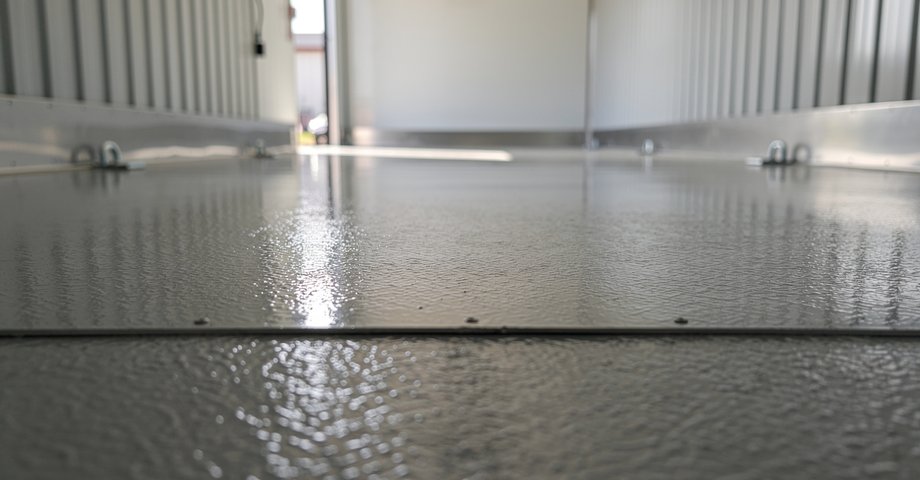
A bonded coating works differently. Instead of sitting on top, it adheres to the substrate and forms a seamless, sealed surface with no edges and no gaps for water to sneak under. Nothing soaks in because there's nothing exposed to soak into.
Now, an honest point. A coating needs sound material under it. If the plywood is already badly rotted or the steel is heavily corroded, that condition has to be dealt with before any coating goes down — and that's exactly the kind of thing we look at in person during the estimate. We're not going to tell you to coat over a floor that's already failing.
Built for Durability
Durability is what our floor coatings are about. A trailer floor lives a harder life than almost any floor we coat — rolling loads, shifting cargo, hooves, pressure washing, the works. Durability under that kind of punishment is the entire reason you'd coat a floor in the first place.
Trailer floor coatings are part of our epoxy flooring and coatings work. That means your trailer gets the same approach we bring to floors that live under vehicles and daily foot traffic. Same approach, same standard.
If your floor is hiding something under that mat, the smartest move is to look now rather than later. Call us at (910) 899-8587 and we'll come take a look before it gets worse.
Non-Slip Footing for Horses, Cargo, and Boots
For anyone hauling livestock, footing is the first question — and it should be. A wet floor with a slick finish is a real hazard for an animal trying to keep its balance in a moving trailer. The way a coating handles that is texture. A broadcast or textured finish builds grip right into the surface, so a wet floor still gives hooves, boots, and shifting cargo something to hold onto.
This is where function leads and good looks come along for the ride. A sealed, lighter-colored floor doesn't just resist moisture — it makes spills, manure, and debris easy to spot and easy to rinse out. No absorbent wood soaking it up, no seams catching it. You see the mess, you wash it out, you're done. The exact texture that fits your trailer is something we sort out when we see how you use it.
Enclosed, Cargo, and Livestock Trailer Applications
Different trailers ask different things of a floor, so it helps to think about how you actually use yours. In a cargo or enclosed trailer, the floor takes a beating from toolboxes dragging, dollies rolling, and equipment sliding around — plus moisture that gets sealed inside once the doors are shut. A coating gives that floor a tough, waterproof surface instead of bare wood that swells and splinters.
Livestock and horse trailers deal with urine, washdown water, and constant wet-dry cycles, which is about the worst thing you can do to an untreated deck. Here the sealed, seamless surface earns its keep, keeping liquid off the substrate entirely and letting you rinse the whole floor clean. Whether it's a utility trailer around Oak Island or a horse trailer heading out of Leland or Calabash, the floor's job is the same — keep moisture out and give you a surface that lasts.
Getting Your Trailer Floor Coated in Southport
Every trailer floor is a little different, so we don't guess from a phone call. The right starting point is an in-person look — the size of the trailer, the condition of the substrate under that mat, and how you put it to use. From there we can tell you honestly what the floor needs and what makes sense.
We handle trailer floor coatings throughout Southport, Shallotte, and the surrounding coastal communities. If you've peeled back a mat and found something you didn't like, don't wait for it to spread. Call (910) 899-8587 and we'll come take a look before that soft spot turns into a bigger problem.